
Portugal Visa Programme
Portugal’s Residence Permit for Investment Activity, commonly called the Golden Visa or ARI, remains open to qualifying non-EU nationals. New real-estate purchases and passive capital transfers no longer qualify. Current routes focus on culture, research, job creation, non-real-estate collective investment vehicles and qualifying Portuguese businesses.
Programme summary
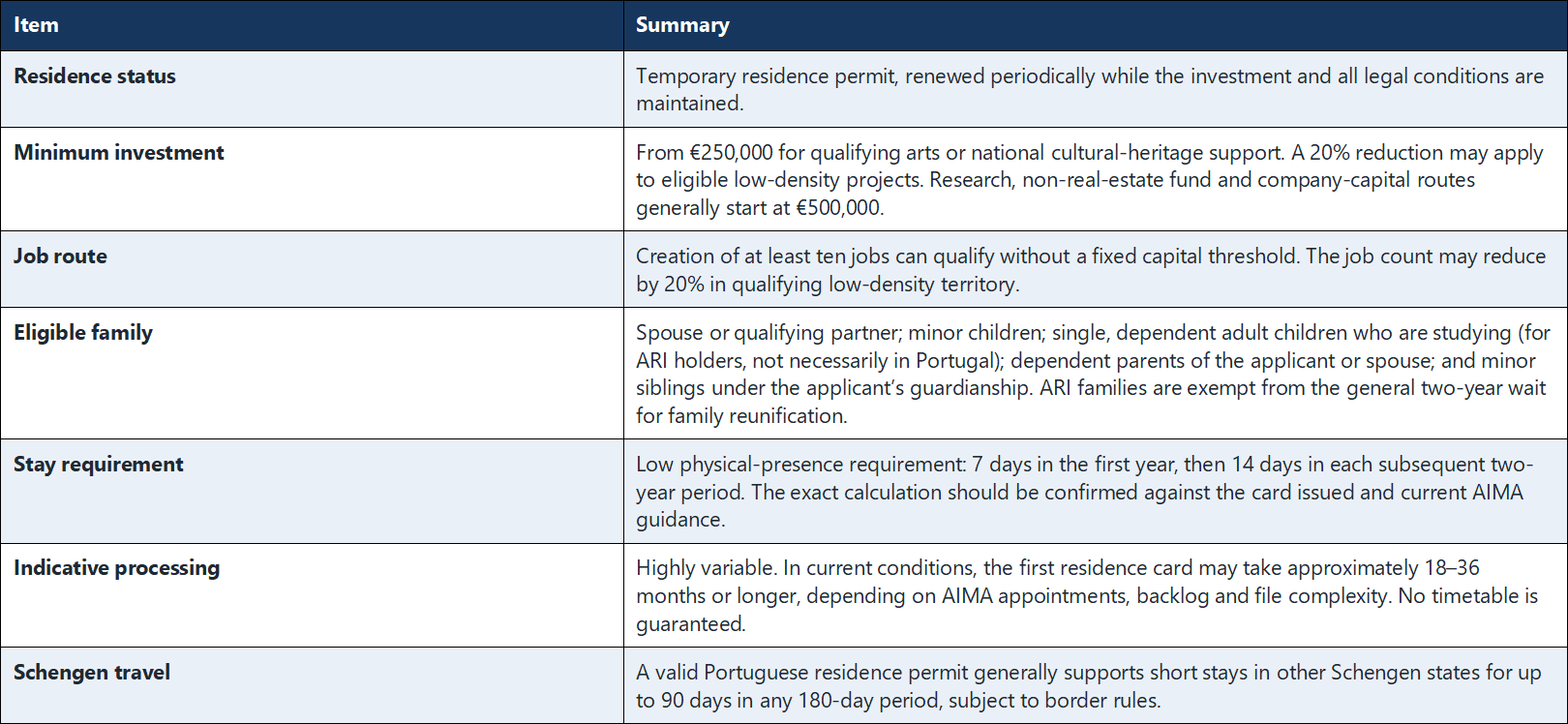
Main advantages
- A low physical-presence requirement compared with ordinary residence routes.
- The right to live, study and work in Portugal while the residence permit is valid.
- Eligible family members can apply through family reunification.
- A valid permit supports short-stay travel within the Schengen Area.
- It may create a route to permanent residence or citizenship if the separate legal requirements in force at the relevant time are met.
Important limitations
- New property purchases and simple capital transfers are not qualifying Golden Visa investments.
- The investment activity must generally be maintained for at least five years and for as long as required to support the residence status.
- The cultural route is normally a non-refundable contribution. Fund and business routes carry market, manager, liquidity and capital-loss risk.
- Qualifying fund structures may not be used directly or indirectly for real-estate investment, and must satisfy Portuguese formation, maturity and investment-allocation rules.
- AIMA processing and appointment times can be lengthy and are not controlled by JDT Global.
- Permanent residence and citizenship are separate applications, not automatic benefits. Portugal changed its nationality law in May 2026, and transition rules may affect individual cases.
Simple application process
- Pre-assessment. Confirm nationality eligibility, family composition, source of funds and the most suitable qualifying route, with independent legal, tax and investment advice.
- Set up the Portuguese requirements. Obtain a tax number, open any required banking or custody arrangements and appoint the relevant regulated professionals.
- Complete the qualifying activity. Make the cultural, research, fund or business investment, or create the required jobs, and obtain the official supporting evidence.
- File the ARI application. Submit the online application, supporting documents and fees, then wait for the AIMA appointment and complete in-person biometrics.
- Receive and maintain the permit. Keep the investment in place, meet the minimum stay, maintain compliant records and renew before the residence card expires.
Frequently asked questions
- Can I still qualify by buying property in Portugal?
No. New real-estate acquisitions no longer qualify for the ARI. The programme continues through cultural, research, job-creation, non-real-estate fund and qualifying business routes. - What is the lowest current amount?
The headline minimum is €250,000 for qualifying support of arts or national cultural heritage. An eligible low-density project may benefit from a 20% reduction to €200,000. Availability and certification must be checked before committing funds. - How much time must I spend in Portugal?
The current framework requires 7 days in the first year, then 14 days in each subsequent two-year period. Travel evidence should be retained, and the requirement should be checked against the applicant’s specific card and current guidance. - Can my family apply with me?
Yes. Family reunification can cover a spouse or partner, minor children, single dependent adult children who are studying, dependent parents of the applicant or spouse and, in limited cases, minor siblings under guardianship. ARI holders are exempt from the general two-year waiting period that now applies to most other residence permits. Proof requirements vary. - Does the Golden Visa guarantee Portuguese citizenship?
No. Citizenship is a separate legal process. Under the nationality rules effective from 19 May 2026, the residence period is generally seven years for EU nationals and nationals of Portuguese-speaking countries and ten years for other nationals, counted from issuance of the first residence permit, with language, criminal-record and other conditions. Transition rules require individual advice.